As the days start to shorten, and we begin hunkering down for the winter, we start craving comfort food. And a bowlful of this nourishing winter Italian minestrone soup is the perfect remedy. A celebration of winter flavours, with the flexibility of adding in ingredients you have on hand, which makes this soul-warming dish even more versatile. Minestrone soup is a one-pot wonder guaranteed to chase away the winter chill with every satisfying spoonful.
Minestrone translation: ‘big soup’
Originating in ancient Rome, minestrone evolved as a way for Italian cooks to make the most of whatever vegetables were in season: whether that’s leftover odds and ends or cupboard staples. There’s no single ‘authentic’ recipe because every region, every season, and even every family, brings its own interpretation. Northern Italian versions might feature rice or potatoes, while Southern recipes lean toward pasta. Coastal areas add seafood, while inland versions stick to vegetables and beans.
What unites all minestrone is its philosophy: waste nothing, celebrate seasonality, and create something nourishing from humble ingredients. It’s cucina povera (peasant cooking) at its finest, proving that the most satisfying meals often come from making do with what you have.
Minestrone soup: Italian comfort in a bowl
Few soups embody the spirit of Italian cooking quite like minestrone—a gloriously chunky, vegetable-packed bowl that transforms simple ingredients into pure comfort. The beauty of minestrone lies in its flexibility. It’s the soup that adapts to your fridge, your cupboard, your season, and your mood.
To get you started on your journey to find your family favourite recipe, I’m providing you a formula for winter minestrone that delivers in our house. Check out the notes for some hints and tips on variations. But whether you like it super thick or more broth-like, prefer pasta over beans (or both!), your family will be mopping up every morsel.
Other soup recipes
Below find more inspiration for some warming winter soup recipes:
- Creamy carrot and lentil soup
- Carrot and coriander soup
- Spiced roasted butternut squash soup
- Roasted cauliflower cheese soup
- Curried parsnip soup with chilli oil
- Celeriac soup with garlic croutons
Growing Cavolo Nero/Kale
Kale and Cavolo Nero are brilliant for UK gardens – one of the most reliable vegetables you can grow, especially since it actually improves in flavour after a frost. These types of brassicas aren’t fussy on where you plant them. But they do like well-drained soil and would appreciate the addition of compost when preparing the soil. They also tolerate shade better than some vegetables, and therefore can help to plug that gap in your garden.
I usually start seeds in modules in the greenhouse, but they can be sown directly in the ground about 1cm deep. Kale grows quite large, so give it room. I’ll plant seeds from April through to the autumn, giving me a crop from summer through to early spring. I would suggest netting your plants (this year I have my brassicas under a mosquito net!) to keep them safe from cabbage white butterflies whose offspring will wipe out a plant in a matter of a couple of days!
Varieties of Cavolo Nero/Kale to grow
‘Dwarf Green Curled’ is compact and hardy, ‘Cavolo Nero’ (black kale) is particularly cold-hardy and delicious, and this year I’m trying ‘Black Magic’ which seems to be doing well (pictured here).

To make this dish vegetarian simply omit the bacon and use vegetable stock
I normally have a small sealed bag of parmesan rinds in the fridge ready to throw into a soup such as this. If you don’t, that’s not a problem. But next time you get to the end of your wedge of parmesan, think of keeping it to add further depths to your soups.
There are many things that could work in this soup other than cannellini beans. You could try an alternative bean – such as borlotti – or indeed a can of brown/green lentils.
Some people can find cavolo nero a little bitter. Personally I love the taste. But that is why the recipe calls for cavolo nero or kale. Kale will bring the dark green earthiness but will be slightly less bitter than cavolo nero. Or to keep the leafy green, you could add in spinach. But if you choose spinach then add this literally a couple of minutes before the cooking time is up.
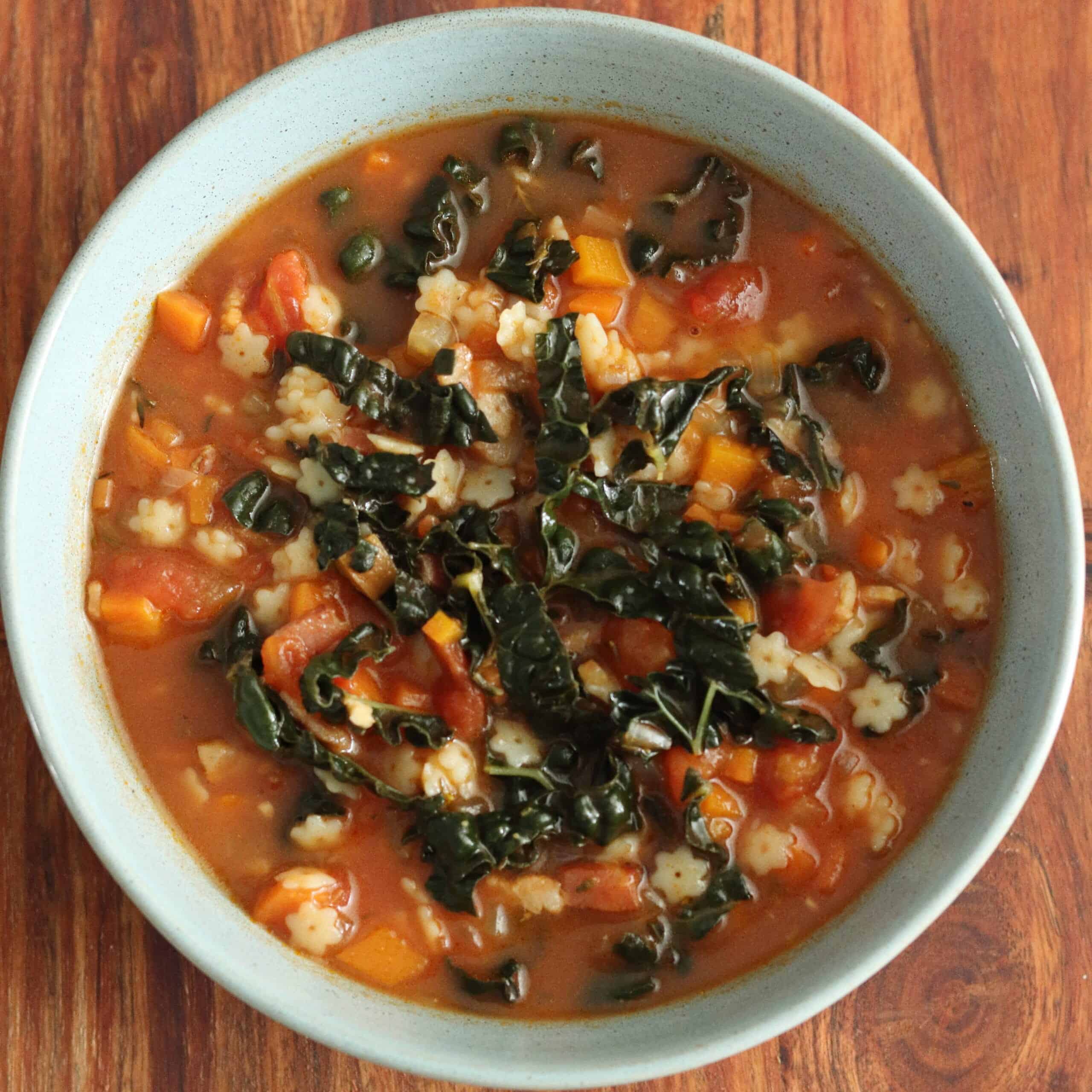
Italian Minestrone Soup
Equipment
- large hob to table casserole dish with a lid
Ingredients
- 1 tbsp olive oil
- 4 slices streaky bacon
- 1 onion diced
- 1 carrot diced
- 2 sticks celery diced
- 2 cloves garlic crushed/grated
- 1 tbsp tomato puree
- 400 g tin chopped tomatoes
- 750 ml chicken stock or vegetable stock
- 1 bay leaf
- 2 sprigs of thyme
- 1 rind of parmesan optional see notes
- 400 g tin of cannellini beans
- 80 g small pasta
- 100 g cavolo nero or kale
- Salt and pepper
- Parmesan/pecorino to serve
Instructions
- If you’re making this recipe vegetarian, skip to step 3. Finely chop the streaky bacon, I find it’s much easier to snip with scissors.
- Add to the large-lidded casserole dish along with the olive oil. Fry on a high heat for a few minutes, stirring occasionally, until starting to brown and released the fat.
- While this is happening, finally dice the onion, carrot and celery. Once the bacon is cooked, add the chopped vegetables to the dish. If you’re making this vegetarian, you will do so with 1 tbsp of olive oil.
- Cook over a medium high heat until the onion is softening but not colouring. This will take around 10 minutes.
- Add in the garlic, stir for a minute, followed by the tomato puree for another minute.
- Pour in the tin of tomatoes and then add in your hot chicken stock together with the bay leaf, thyme and the parmesan rind, bring to the boil and then cover and simmer for 20 minutes.
- Remove the central cores of the cavolo nero or kale and slice. Add the can of drained and rinsed cannellini beans along with the cavolo nero, then finally pour in the small pasta. Then stir gently. I prefer to keep the pasta just in the liquid, sitting on top of the leaves, as I find if it sinks to the bottom it’s likely to stick.
- Cover the casserole with the lid, cook for the time that the pasta indicates (normally for small pasta around 7 minutes).
- Serve in wide bowls alongside grated parmesan and crusty bread if you wish. Although this soup is certainly filling enough!
Notes
- To make this dish vegetarian simply omit the bacon and use vegetable stock
- I normally have a small sealed bag of parmesan rinds in the fridge ready to throw into a soup such as this. If you don’t, that’s not a problem. But next time you get to the end of your wedge of parmesan, think of keeping it to add further depths to your soups.
- You can always think of replacing the cannellini beans with another bean – such as borlotti – or indeed a can of brown/green lentils.
- Some people can find cavolo nero a little bitter. Personally I love the taste. But that is why the recipe calls for cavolo nero or kale. Kale will bring the dark green earthiness but will be slightly less bitter than cavolo nero.