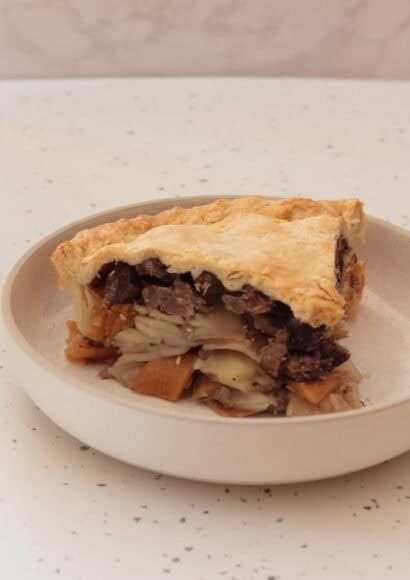
This is my take on a Cornish classic – the pasty. This is now not only a favourite in Cornwall, but all over the UK. You can find shops selling a variety of weird and wonderful fillings. But there’s only one true pasty filling. In my pasty pie recipe, you’ll only find: rough-puff pastry; potato; turnip; onion; skirt beef; and seasoning. Pasty pie is a great addition to any cook’s pie repertoire.
To be a pasty or not to be
I’m not saying for a second that my recipe is for a ‘Cornish Pasty’. I don’t want to be lynched when I return home to Cornwall LOL! The ‘Cornish Pasty’ has protected status, much like other culinary greats such as Champagne, Parmigiano-Reggiano, or Scotch Whiskey. My version of a traditional pasty pie – a reimagined classic – is a third-generation adaptation based on the original.
Third-generation journey to my pasty pie – a reimagined classic
My Granny, and in particular my Great-Auntie Doreen, would handmake pasties for the whole family. They were baked on butter papers, wrapped up, and eaten still slightly warm on the beach at Falmouth. I can remember the smell of them cooking, the warmth of them in the bag, and the amazing taste mingled with the salt air. The pastry was a rough puff, the butter sliced into thin shards, matching the potato and the turnip. By the way, a turnip in Cornwall is in fact known everywhere else as a swede!
My Mum then took the same ingredients and made a ‘time saving’ version of a pasty for her family, encasing everything in a pie. A great way to put a Cornish dish on the dinner table that not only saved time but also effort. Filling and crimping 5 individual pasties for the family took a lot longer than lining and topping a pie dish with pastry.
Another generation on, I like to cut back a little on the pastry element of the dish, whilst not messing with the filling. My version is a pie that’s only topped and crimped with rough-puff pastry. I love cooking this pie in a clear, round Pyrex dish, where I can see all the filling ingredients bubbling away and creating that amazing smell throughout the house.
History of the Cornish Pasty
The pasty originated in the tin mining community of Cornwall in the 17th and 18th centuries. The thick, crimped edge would act as a handle for the miner’s dirty hands. When finished, they could throw away the sooty, crimped edge. Traditionally, one end would be savoury, whilst the other end would be filled with something sweet. As the miners and their skills travelled the world, so did the pasty, where it could be found in places like Australia, the USA, and Mexico.
Other warming one-pot recipes
Other one-pot pie recipes on the blog include:
The traditional way is to shave the potato and turnip but hand. But if you prefer to dice them then please do so. It’s not changing the flavour, just the look of it. And at the end of the day, it’s the flavour that counts!
My simple answer… no! If you did, then it wouldn’t be a pasty pie. It would be a different pie 😉 However, some people add a little freshly chopped parsley into the meat filling. And if have a tub of clotted cream in your fridge, then instead of butter you could add in a few dollops of Cornish clotted cream :-). As we’d say in Cornwall, “Proper Ansum”!
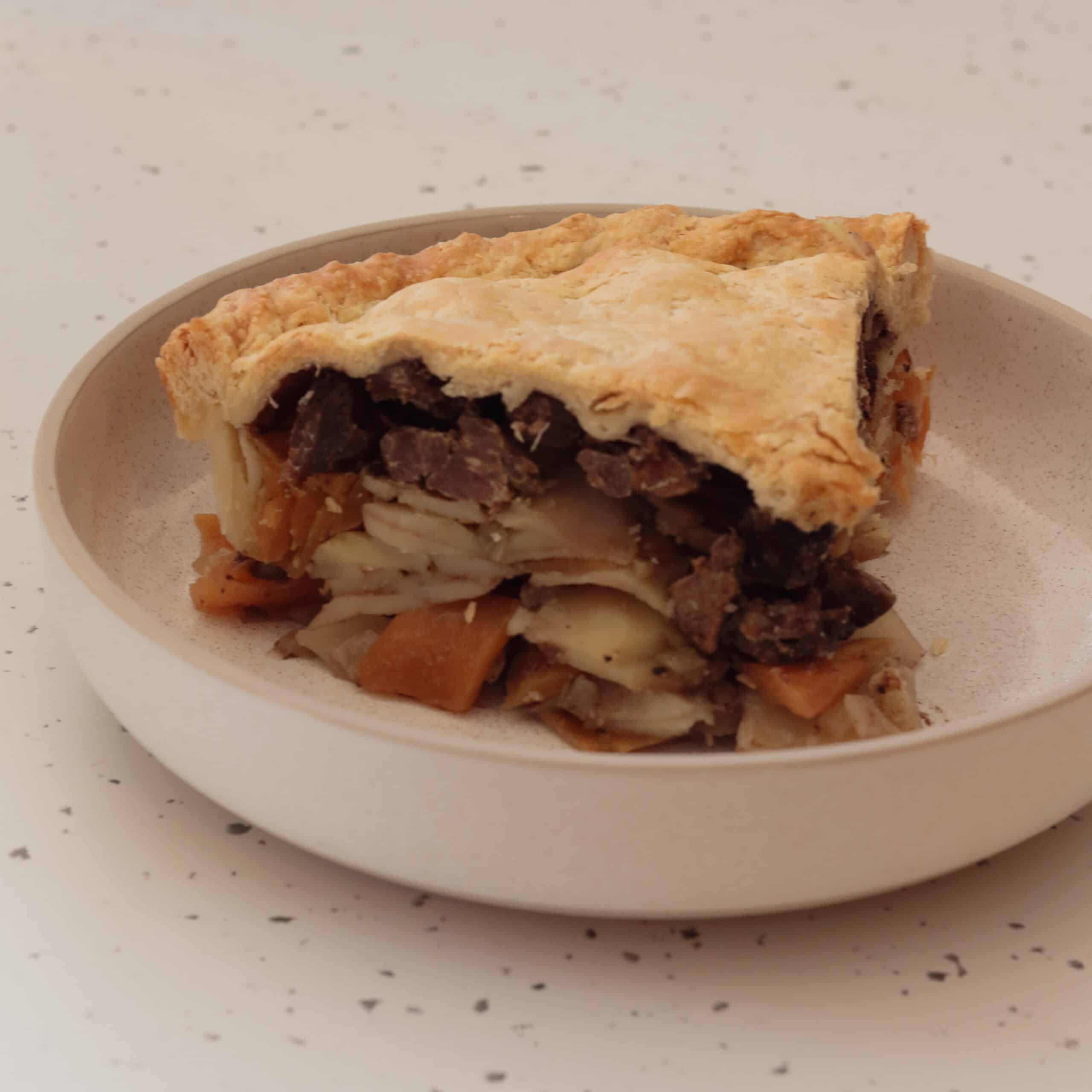
Pasty Pie – a reimagined classic
Equipment
- Large round pie dish
Ingredients
- 500 g turnip (aka swede) Turnip = Swede in Cornwall!
- 500 g potatoes
- 1 onion large
- 500 g skirt beef or chuck steak
- 250 g plain flour
- 165 g butter very cold – popping the butter in the freezer for 30 minutes helps
- 2 1/2 tsp salt
- 1 1/2 tsp freshly ground black pepper
- 1 tbsp milk
Instructions
- Make your pastry by weighing out your flour into a large bowl. You want to slice/peel 150g of the very cold butter into the flour using a vegetable peeler or a sharp knife. You're aiming for a rough-puff pastry which keeps the layers of the butter in the pastry. Put 10g butter aside for the end.
- Add 1 tsp of salt, 100ml of cold water, and gently start to bring the mixture together. You don't want to achieve a breadcrumb texture, as with shortcrust pastry, but keep visible slices of butter. So don't rub the flour and butter, simply push it together. It should need around 150ml cold water in total, but add sparingly after the initial 100ml until it binds into a ball. Wrap and pop it into the fridge for 30 minutes.
- Meanwhile, to prepare the vegetables for the filling, peel the turnip (swede) and the potatoes. Cut the turnip into quarters. You now want to use a sharp pairing knife and carefully shave them into small, thin chunks. If you don't feel comfortable doing this, you can dice the veg – see notes below.
- Dice the onion and stir this into the turnip and potato mix along with 1 tsp of salt, 1 tsp of freshly ground black pepper, and 6 tbsp of water. Give everything a good mix, cover, and set aside for the flavours to develop.
- Heat the oven to 170 °C
- Meanwhile, take your skirt beef/chuck steak and dice into small pieces (approximately 1/2 cm dice).
- By now, your pastry should have had 30 minutes in the fridge and have firmed up a little. Dust some flour on your worktop and your rolling pin, and roll out to around 3mm thick (about the thickness of a £1 coin) to slightly wider than the shape of your dish. You'll use the overlap to crimp the edges.
- Pour the turnip, potato and onion mix into your pie dish and roughly flatten out. Top evenly with the diced chopped beef, taking it almost to the edge but not quite. Give the top of the beef another good seasoning (remaining 1/2 tsp salt and 1/2 tsp freshly ground black pepper) and dot over the final 10g of butter.
- Transfer your pastry to the pie dish by rolling it around the rolling pin and then gently unrolling over the dish. You should have a slight overhang all around the dish. You then want to crimp the edges of the pie in a 'pasty' style. Pushing it into the edge of the dish with your thumbs and first fingers. Finally, put a small hole in the centre of the pie to allow some of the steam to escape, and brush all over with milk.
- Bake in the centre of the oven for 1hr 30 minutes at 170 °C
- If the pastry starts to brown too quickly, loosely lay a sheet of foil over the top.
- Remove from the oven after 1hr 30 minutes and allow to stand for 10 minutes before slicing and serving.
Notes
- It’s not traditional to dice the vegetables. It is preferable to shave them – but not everyone is comfortable doing this with a knife in their hands and peeling off small slivers/chunks. If you do decide to dice the veg, it will need to be relatively small – around 1/2cm
- Before the pastry topping goes on you can sprinkle the meat with some fresh chopped parsley if you wish. I’m just a pasty purist and only add seasoning!
- I always find it’s easier to roll pastry out to a rough circle, hence I choose to bake this pie in a round baking dish.