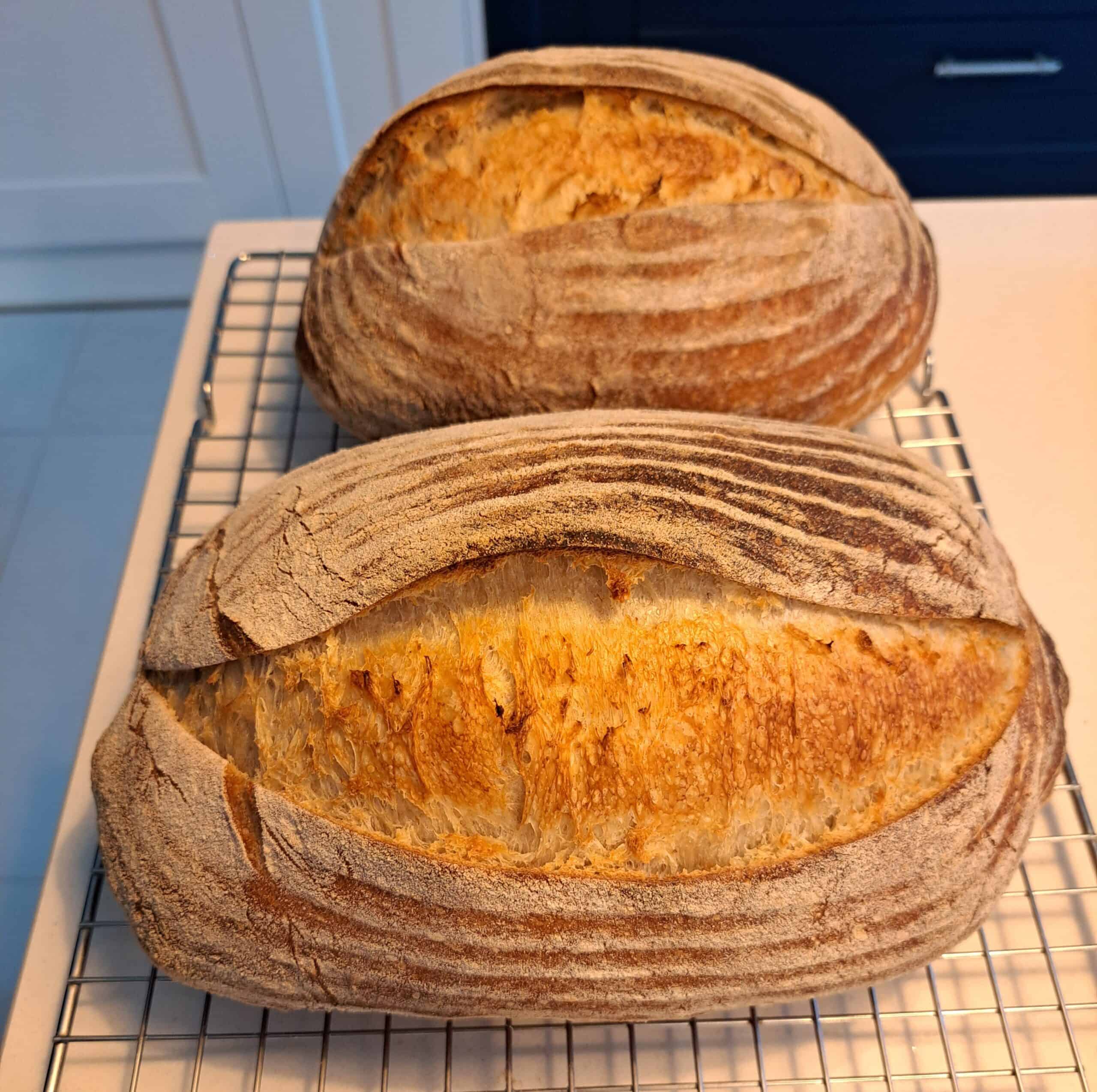
Overnight Sourdough Bread
This is the method I follow to get the best results in my kitchen when making overnight Sourdough bread. It takes time and a bit of effort, but biting into warm, freshly baked sourdough is worth every minute.
Servings: 3 loaves
Calories: 1885kcal
Equipment
- large enamel or glass bowl
- cover for your bowl
- bread baskets with covers
- bread lame blade
Ingredients
Refresh Starter
- 20g Mother
- 100g white bread flour
Sourdough Leaven
- 25g refreshed starter
- 100g white bread flour
Sourdough Bread
- 225g sourdough leaven
- 1000 g white bread flour plus extra for dusting or a mix of 800g white bread and 200g light rye flour
- 1 tbsp fine sea salt
- 1 tsp malt powder optional
- 100 g mixed bread seeds optional
- 3 tbsp rice flour
Instructions
- 10am Day One - I refresh the starter. Taking the 'mother' from the fridge, I put 20g in a large, clean, jam jar. Adding 100g of white bread flour and 100ml warm (but not hot) water, give everything a really good stir. I don't know why, but I use a chopstick for this! I find I lose less of the dough and it's easy to clean.
- Cover the jam jar, I have a reusable plastic cover, I put an elastic band around the jar to mark the height of the starter, and place in an ambient place in your kitchen until doubled in size. You don't want it to be too cold or warm - around 20-22 °C is perfect. Depending on the time of year, you'll notice that the timing of this can vary a lot. This is where you need to take your time and get used to how your dough reacts at the various stages. Your mother is perfect to use when it's doubled in size - hence the use of the elastic band to track it's growth.
- 10pm Day One - I use the refreshed starter to make my leaven. Taking 25g of the refreshed starter and placing it in a large, clean jam jar, I add in 100g white bread flour and 100ml warm water. Mix together and once again cover and leave on the worktop in the kitchen overnight. The remainder of the refreshed 'mother' goes in a sealed jar in the fridge until needed again.
- 7-8am Day Two - You should have 225g leaven ready to use to make your sourdough. Pour into a large bowl (enamel or glass), to this mix in 600ml of warm water thoroughly. Then add in 1kg flour (I use all white bread flour or opt for 200g rye flour and 800g white bread flour). At this stage you just want to mix the dough to a dry, shaggy, consistency. It won't look pretty, or anything like bread dough at this stage, but don't worry. Cover the bowl and leave to stand in the kitchen for 30 minutes. I use a large plastic cover - like a big shower cap!
- After 30 minutes, you want to slowly add more warm water until you reach 700-750ml in total. * See note below * I normally do this with 2 x 50ml and then a final 25-50ml (depending on the dough hydration). Each time, mix well, scraping the sides down, re-cover and leave for 20-30 minutes. With the final 25-50ml of water, I also sprinkle on 1 tbsp of table salt. It's optional, but to get a browner crust, I also add in 1 tsp of malt powder. If I want a seeded loaf, I would add in 100g seeds now as well. Give everything a good mix to combine and cover.
- After 15 minutes, you want to then start 'folding' your dough. Lift up the dough in the middle until the ends fold in underneath. Turn the bowl 90 degrees and repeat for 4 folds in total. You want to then repeat this every 15 mins for a total of 4 times. You should now have a smooth looking dough that's ready to prove. Leave this to double in size. There is no specific time, but anywhere from 2-4 hours, depending on the temperature in your kitchen.
- Once the dough has proven, tip it onto a floured worksurface and divide into 3 equals pieces. Shape into 3 balls, using your scraper and your hands keep pulling the ball towards you. You want to add tension to the dough at this stage. The more tension you create on the surface of the dough the more likely you are to create a good rise in your loaf. There are a tonne of videos online showing you this technique.
- Leave the shaped loaves to 'bench rest' on the worktop for 30 minutes. Prepare your baskets by dusting them liberally with rice flour. I try and press it into the ridges of the baskets. There is nothing worse than a loaf that sticks in the baskets when you try to turn them out!
- Flip your sourdough ball over, and fold in each of the 4 corners into the centre. Then roll it up into a sausage shape. I create an oblong as my baskets are this size, but you might have round baskets, in which case shape as required. Place the sourdough loaves into the floured baskets with the seamside up, squeezing together any loose seams to capture the air inside, and cover with plastic covers. Place on the top shelf of your fridge and leave overnight.
- First thing Day Three - Heat the oven to 225 °C . When the oven is at temperature, dust a non-stick baking sheet with a little flour, tip out your sourdough loaf, and brush off any excess flour from the loaf. Throw 4-5 icecubes into the bottom of the oven, to create steam, and place your loaves in the middle of the oven. Set a timer for 5 minutes.
- After 5 minutes, remove from the oven and slash with your sharp lame blade from end to end. I have tried many times slashing the loaf initially before placing it in the oven with very mixed results. But allowing a slight crust to form before slashing seems to give me consistent results, and better 'ears'!! Return to the oven for 25 minutes.
- When the time is up, allow the loaves to cool for at least an hour. Freshly cooked sourdough is notoriously difficult to slice if it's too warm. Enjoy the fruits of your labour.
Notes
- I'm adding in 725-750ml of water to 1 kilo of flour and 225g of starter. When starting out on your sourdough journey, you might want to just add 700ml of water. The more 'hydration' you add to the sourdough the more difficult it can be to work with. If you want to learn more about it search online for 'sourdough hydration' and you'll see that standard hydration is 65-75% whilst 75-85% is a high hydration. I'll go up to 80%, but I find that 70-75% is the sweet spot for a manageable dough.
- I use rice flour to dust my baskets as I find this really helps stop the dough from sticking, but you can use bread flour.
- To cover my baskets whilst rising in the fridge, I use shower caps!
Nutrition
Calories: 1885kcal | Carbohydrates: 383g | Protein: 61g | Fat: 9g | Saturated Fat: 2g | Polyunsaturated Fat: 4g | Monounsaturated Fat: 1g | Cholesterol: 2mg | Sodium: 2364mg | Potassium: 752mg | Fiber: 19g | Sugar: 5g | Vitamin A: 24IU | Vitamin C: 0.2mg | Calcium: 105mg | Iron: 7mg